The Complete ESG Guide: Understand, Implement and Report Your Actions
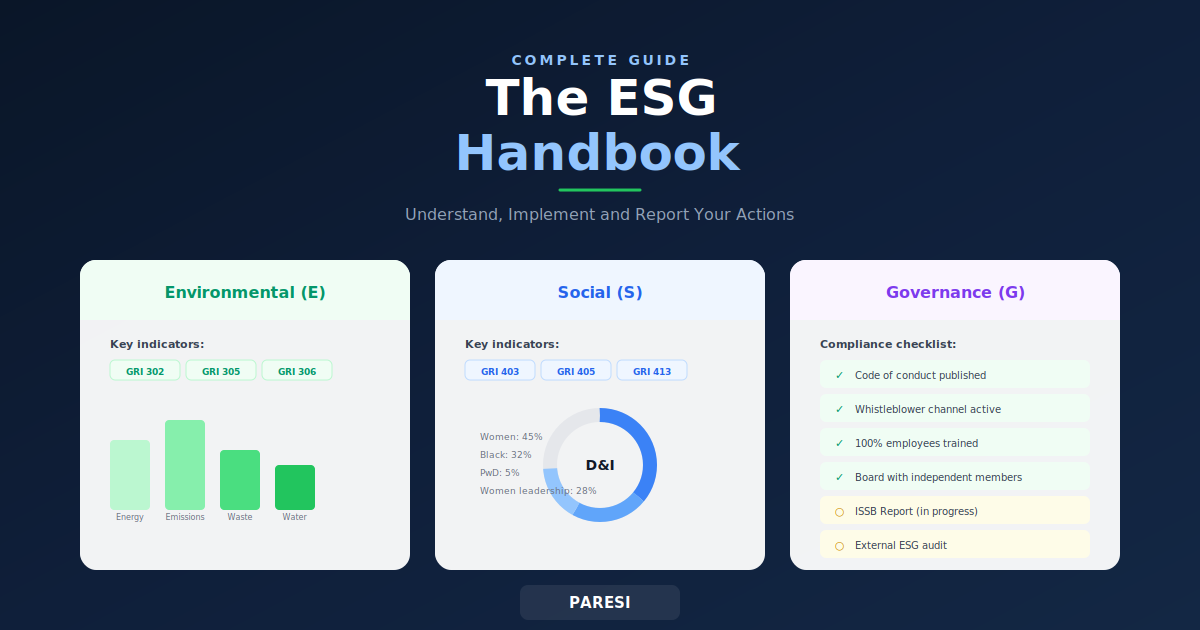
From the early 2000s, when ESG first appeared, to today, a lot has changed. The topic has gained greater relevance in companies, stock exchanges, consumer awareness and public policy. With so many changes, it has become a more complex subject. With that in mind, we created this ESG mini-guide.
What is ESG?
ESG stands for Environmental, Social and Governance. In practice, it refers to what a company does to demonstrate its responsibility toward the environment, social impact and good business practices.
ESG emerged in the early 2000s when Kofi Annan, Secretary-General of the United Nations, presented to the World Bank the challenges that the planet and society would face in the coming decades.
Why should companies invest in ESG?
If in the early 2000s government was seen as the sole entity responsible for preserving the environment and promoting social transformation, today consumers also hold companies accountable. They choose sustainable products and brands that are more inclusive. ESG is not a fad — it is part of the daily reality of business.
How to start investing in ESG?
A good starting point is the Sustainable Development Goals (SDGs) created by the UN Global Compact. There are 17 SDGs, each with its own targets. By selecting the relevant SDGs, your company already has an action plan with defined goals.
Examples of Environmental Actions
- Eliminating disposable cups
- Turning off lights in empty rooms
- Using renewable energy
- Planting trees in deforested areas
- Switching to an electric vehicle fleet
- Using recyclable packaging
- Promoting the circular economy
Examples of Social Investment Actions
- Diversity, Equity and Inclusion programs within the company
- Young Apprentice programs
- Employee family wellbeing initiatives
- Community engagement around the company
- Local supplier policies
Examples of Corporate Governance Actions
- Creating processes for supplier hiring
- Defining processes for the ESG department
- Compensation transparency
- Compliance with labor laws
- Business ethics
- Anti-corruption policies
How to create ESG reports?
Contributing alone is not enough. You need to know which actions are most effective. The key point is that ESG reports go beyond a list of actions and deliver actual results.
In practice, measurement follows four steps:
- Define what will be done and which metrics will be tracked
- Before starting, collect relevant baseline data
- While the action is underway, collect partial data
- When the action is completed, measure the outcome
The Global Reporting Initiative (GRI) is an internationally recognized framework for reporting ESG data. The 200-series indicators relate to Governance; the 300-series to Environmental; and the 400-series to Social.
Conclusion
Paresi empowers social projects to learn how to report data using SDG/GRI standards. This data is audited and made available through a dashboard with the relevant metrics for your company’s ESG planning.
Ready to measure your company’s impact?
Create your free account and start structuring sustainability with GRI indicators and SDGs.
Get in Touch