How to Measure Sustainability in Your Company: A Practical Guide for SMEs
Introduction
Sustainability is no longer a competitive differentiator — it has become a strategic necessity for companies of all sizes. But if you manage a small or medium-sized business, you’ve probably asked yourself: where do I even start measuring my company’s impact?
The good news is that measuring sustainability doesn’t have to be complex or expensive. With the right indicators and a clear methodology, any company can begin its sustainability journey and deliver tangible results.
What does measuring sustainability mean?
Measuring sustainability is the process of collecting, organizing and analyzing data about an organization’s environmental, social and governance (ESG) impact. This includes indicators such as energy consumption, greenhouse gas (GHG) emissions, waste management, workforce diversity, social investment, among others.
Measurement allows a company to understand where it stands, set realistic goals and track progress over time. Without data, there is no management — and without management, there is no progress.
Why should SMEs care about sustainability?
Market demand: Large companies are requiring ESG practices from their suppliers. If your company is part of a value chain, measuring sustainability may be a requirement to maintain contracts.
Access to credit and investment: Financial institutions and investors are prioritizing companies with sustainability indicators.
Growing regulation: New regulations such as the CSRD in Europe and similar initiatives in Brazil are expanding the mandatory scope of sustainability reporting.
Operational efficiency: Monitoring energy, water and waste consumption frequently reveals cost-reduction opportunities.
The 3 pillars of ESG measurement
Environmental
Involves measuring a company’s impact on the environment. The most common indicators include: electricity consumption and renewable sources, GHG emissions inventory, solid waste generation and disposal, and water consumption and reuse.
Social
Covers the company’s impact on people and communities: diversity and inclusion, education and training programs, occupational health and safety, and investment in social projects.
Governance
Refers to management practices and transparency: corporate governance structure, anti-corruption policies, and transparency in information disclosure.
Which indicators to use? GRI and SDGs as a reference
GRI Indicators
GRI is the most widely used standard in the world for sustainability reporting. It offers standardized indicators that enable comparison between companies. There are over 150 indicators organized by topic, such as energy (GRI 302), emissions (GRI 305), waste (GRI 306), and diversity (GRI 405).
Sustainable Development Goals (SDGs)
The 17 UN SDGs serve as a global agenda for sustainable development through 2030. Aligning your company’s actions with the SDGs helps communicate impact clearly and in connection with globally recognized objectives.
Step by step: how to start measuring
1. Define your priorities — You don’t need to measure everything at once. Start by identifying the most relevant topics for your business.
2. Choose the right indicators — Based on your priorities, select the corresponding GRI indicators. For most SMEs, 10 to 20 indicators are sufficient.
3. Organize data collection — Define who will be responsible for collecting each data point, how often, and in what format.
4. Use the right tool — Spreadsheets work at the beginning, but quickly become limiting. A dedicated platform allows you to centralize data and generate reports.
5. Set goals and track progress — Data without goals doesn’t drive action. Set clear objectives for each indicator.
6. Communicate results — Sustainability creates value when it’s communicated. Share results with employees, clients and partners.
How technology can help
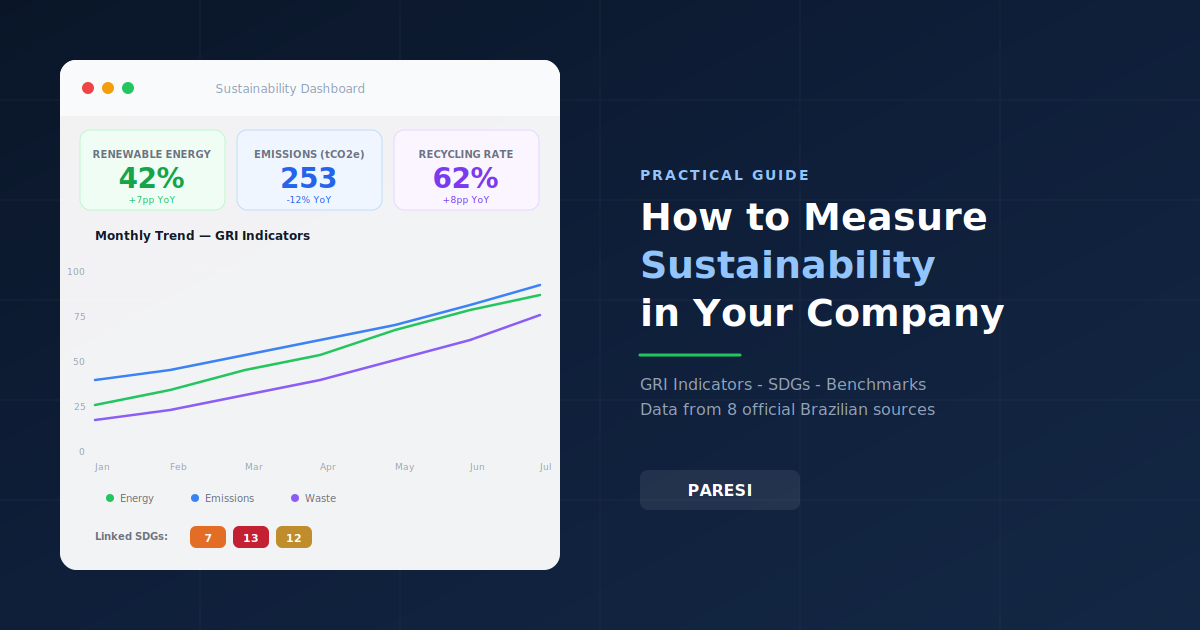
Digital tools are essential allies for SMEs looking to professionalize sustainability management. A good platform offers: pre-configured indicators based on standards like GRI, data collection forms, dashboards with evolution charts, automatic SDG alignment, and smart analytics that turn data into actionable insights.
The Paresi Platform was built specifically for companies that want to start their sustainability journey. With GRI indicators, 17 integrated SDGs and data from official Brazilian sources, it simplifies the entire process.
Conclusion
Measuring sustainability is no longer a luxury reserved for large corporations. With the right indicators, a clear methodology and the proper tools, any company can start its ESG journey and turn data into smarter decisions.
The first step is the most important: start small, stay focused, and evolve progressively.
Ready to measure your company’s impact?
Create your free account and start structuring sustainability with GRI indicators and SDGs.
Get in Touch